
Bayesian Reconstruction of Epidemic Cases & Hospitalizations (BRECH). Simulation and Bayesian fitting of stochastic epidemic models.
The package name comes from the Welsh word for “rash”
Overview
This package was designed with the main purpose of rapid construction and prototyping of stochastic infectious disease models in a small (~100 individuals) to medium (~1000 individuals) size settings. This ease of construction does come at the cost of computational efficiency and so would not be recommended for larger settings or with more complicated dynamics with multiple rates.
Installation
The latest version of brech can be installed from the CRAN with:
install.packages("brech")You can install the development version of brech from GitHub with:
# install.packages("pak")
pak::pak("BCCDC-PHSA/brech")
Example
The package’s base class stochastic_model defines the stochastic processes’ events, rates, parameters, and initial states. The example below generates a simple process where infections (I) are generated at a constant rate (beta)
library(brech)

reactions <- list(
  infection = list(
    transition = c("I" = +1),
    rate = function(x,p,t){p$beta})
)
example_scenario <- list(
  params = list(beta = 0.1),
  initial_states = list(I = 0),
  sim_args = list(T = 100)
)
sm <- stochastic_model(reactions,example_scenario)

print(sm)
#> Stochastic Model
#> ==================
#>
#> Initial Values:
#>   I : 0
#> Parameters:
#>   beta : 0.1
#> Simulation arguments:
#>   T : 100
#> Reactions:
#>  - infection:
#>    Transition: [I +1]
We can generate a realization of this process using the function run_sim and plot the result
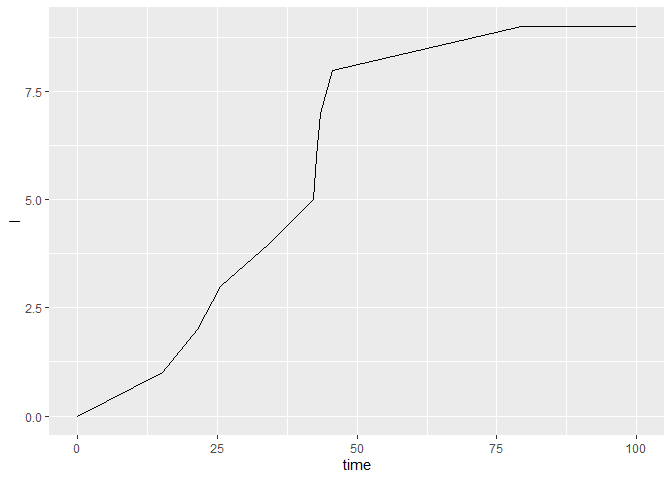
The package provides more tools for scenario modelling and fitting. See the Introduction vignette for more details by running the following code
vignette("brech", package = "brech")Package structure
A flow chart of the dependency between defined S3 classes in the package is provided below. The base class is stochastic_model which defines the model events, rates, parameters and initial states. A summary of the object can be provided and a simulation can be drawn from the model using the function run_sim(). Model fitting can be performed using the abc_stochastic_model or alternatively a scenario can be generated using the scenario_stochastic_model class. Finally a projection can be generated from either a scenario or model fit using projection_stochastic_model.